A Phoenix Slowly Rising:
Small Triumphs and Sizeable Challenges Nursing in Post Earthquake, in Haiti
I have been approached several times to write something about my experiences of nursing in Haiti for NAPAN, so, on the brink of leaving for my third mission, I decided it was time to accept the invitation to share my thoughts and experiences with a larger audience. There is much to share but finding the words to adequately describe the experience often proves difficult. The challenge for me lies in trying to discern what is it that people really want to know about nursing in a country like Haiti, the fear of telling too much or perhaps not enough. Finding the balance between the happy jubilant moments and the dark, sad and downright heart breaking ones is something I think many team members face when we think of Haiti and our time there.
Arriving at Bernard Mevs Hospital in the capital of Port au Prince after some 13 hours and several flights later we are greeted with tall metal gate, rows of chain link fencing and unsmiling heavily armed guards who we later learn serve as the initial triage team. If you don't pass their inspection, you are not getting into the hospital compound for treatment. The reality is Port au Prince is a dangerous city where it is not uncommon to hear gunfire outside of the gates. We are shuttled into a hot, stuffy un-air conditioned room where daily physiotherapy occurs, to learn about the hospital, what’s available or more importantly what is not available, and a long list of rules which are meant to ensure our safety. Our orientation is interrupted by a frantic paramedic looking for an Emergency doctor. Two of our emergency physicians oblige and follow. A few minutes later the same young man again enters and asks for the plastic surgeon to please come with him. Then anesthesia. We soon learn that the team is officially in action. A police officer has come in with a gunshot wound entering somewhere on his neck and is bleeding heavily and quickly becoming unstable. He was shot while on his way to work. Our team, barely on the ground, has mobilized and, has the man intubated and into the operating room in what seems like record time. And this we are soon to learn is, a day in the life at Bernard Mevs Hospital, the only trauma centre in the country, serving 10 million people. This was my introduction to what is Haiti, dangerous, chaotic, beautiful and at times serene, a place of contradiction.
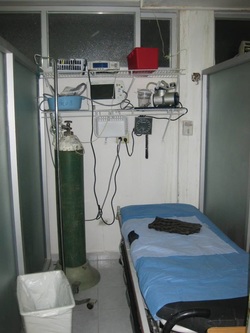
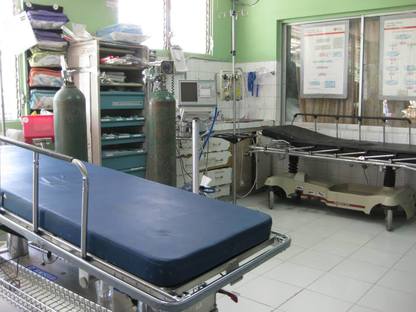
To say resources are scarce is a vast understatement. In the days to come I would learn exactly what it is like to be a healthcare worker in Haiti, the struggles the Haitian staff face daily and, their tremendous efforts to provide care to patients with so little. Things we take for granted like blood work, x-rays, monitoring, medications, dressing supplies, gloves, hand washing facilities are all things which are not always available. The CT scanner for example may or may not be working on any given day. And if the scanner needs to be used in the evening that means that the power supply to the inpatient units must be interrupted. And by interrupted I mean turned off. If there is a power outage (which can occur frequently) and the hospital is running on generator power than the CT scanner cannot be used. There are 4 adult ventilators and 2 pediatric. The population of Port au Prince itself is around 3 million. With so few ventilators this means that physicians must pick and choose who gets them. This translates to a harsh reality; anyone with a C-Spine injury will not be intubated because there are simply not the resources to maintain individuals on ventilatory support indefinitely. These individuals will receive supportive care only. On our first trip we had a child who required ventilatory support but all the vents were in use. Members of our team along with local staff took turns manually bagging the child for the entire night to keep her alive.
This lack of resources forces you to consider every single thing you use, every decision you make. Do I really need three pieces of gauze for this or can I get by with two? Do we really need to draw these labs, will they change our course of treatment? You re-use things that you never imagined possible. You begin to rely heavily on your assessment skills, experience and wisdom. You are the best and sometimes, only tool you have in providing care to patients. You push your skills to the limits and in turn learn a lot about yourself and what you are truly capable of when presented with immense challenges. You draw from an inner strength you may forgotten or never even knew you had.
The system is painfully slow, and nothing is easy. What might take you five minutes to accomplish at home can take upwards of an hour in Haiti. There is no clear path, you often feel as if you are constantly turning in circles to get the smallest of tasks completed. It is exhausting at times. Then there are things you've never considered that arise. The mother of a 2 year old who upon discharge tells you they cannot leave the hospital now because it's dark and the streets are too dangerous. You go about the tedious task of trying to find a sheet no one will miss so that the mother and her child who just had surgery, will not have to sleep directly on the ground in the hospital court yard, where they will wait out the night until it is safe for them to leave. And it is in these moments you can feel an overwhelming sense of helplessness, hopelessness and feel like you just meet the needs and demands of this place. You struggle to find your balance.
To function in a place like Haiti, you must be willing and able to wear many hats. Flexibility and adaptability are the most invaluable traits one can possess here. Patience for a system that doesn’t work at break neck speeds like we are accustomed to in Canada. And as I learned from the Haitian staff, resilience is a must in order to survive here. Finding the positive when everything is crashing in around you and things seem bleak and hopeless, when the burden seems too much, you must keep moving forward. It is a place of chaos and mayhem, but a place that holds strength and hope for a better future. And that is why Haiti keeps drawing me back. The world is unbalanced at best and Haiti is proof of this, a beautiful country and people burdened with poverty but, certainly not without hope. And their hope gives me strength to keep coming back.